This post contains affiliate links. We may earn a commission if you purchase through them, at no extra cost to you.
You know the routine. It’s late, you’re already in bed, and you prop yourself up against whatever pillows you can grab so you can read a bit, reply to one last email, or watch something before lights out. Ten minutes in, you’re shifting around because the pillows have slid apart again. Your neck’s bent at some weird angle. And come morning, your lower back feels like you slept on a rock, and there’s this dull ache in your neck that makes you groan just sitting up.
If you’ve ever searched how to sit up in bed without back pain at midnight while rearranging your pillows for the third time, you’re definitely not the only one and honestly, it’s not really a “you” problem. Regular pillows just weren’t made for this. They’re built to cushion your head while you’re lying flat, not to hold your entire upper body upright for an hour while you read or work off your laptop. Once you get why this keeps happening, fixing it isn’t nearly as complicated as it feels at 11pm with three pillows collapsing behind you.
So let’s get into it.
Why Your Regular Pillows Keep Letting You Down
Think about what a normal bed pillow is actually designed for. It’s soft, it compresses easily, and it has basically no structure to it. Perfect for sleeping. Not so great when you’re leaning your full body weight against it for an hour.
A few things tend to go wrong the moment you try using stacked pillows as a backrest.
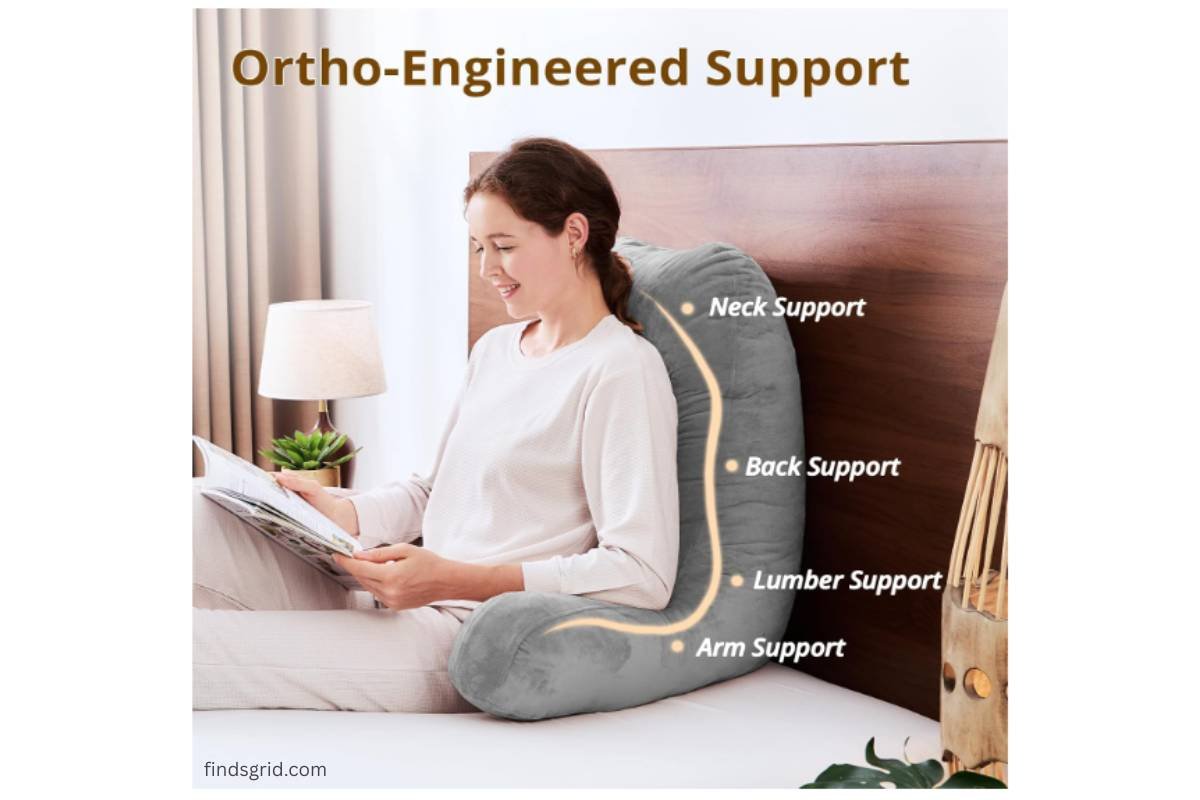
For starters, there’s no real lumbar support. Your lower spine naturally curves in a bit, and if there’s nothing filling that space, your back just collapses into a slouch. That slouching is a big part of why your lower back feels stiff and cranky afterward the pressure lands almost entirely on your lower vertebrae and the muscles trying to hold everything together.
Then there’s the neck issue. Pillows compress unevenly as you use them, so your head often ends up tipping too far forward or getting pushed back further than it should. Either way, your neck muscles are stuck doing extra work just to keep your head balanced, which is usually where that ache at the base of your skull comes from.
Your spine alignment takes a hit too. Good sitting posture, even in bed, means your ears, shoulders, and hips are roughly in line with each other. Loose pillows can’t hold that shape, they shift and flatten the second real weight hits them, so you’re basically out of alignment from minute one.
And if you’re holding a book or a laptop with no arm support at all, your shoulders end up tensing up to compensate, and that tension almost always travels straight into your neck.
Basically, you’re asking sleep-designed bedding to do a sitting-designed job. It was never going to work well.
4 Proven Fixes for Sitting Up in Bed Without Pain
You don’t need to redo your whole bedroom to feel a difference here. A couple of small tweaks can genuinely change how your body feels the very next time you sit up to read.
- Fill the gap at your lower back first, before worrying about anything else. A small firm pillow or even a rolled towel tucked right into that curve does more to stop slouching than piling three extra pillows behind your shoulders ever will.
- Put something under your knees. It feels unrelated to your back, but a pillow under the knees tilts your pelvis slightly and takes real pressure off your lower spine. Try it once and you’ll notice.
- Don’t stack pillows straight up angle them. A slight recline, somewhere around 100 to 110 degrees, is way easier on your spine than sitting bolt upright against a headboard or wall.
- Bring whatever you’re reading up to eye level instead of dropping your chin down to it. Prop the book, tablet, or laptop on something so your eyes are looking slightly down, not your whole neck craning forward. This alone cuts down a lot of neck fatigue.
Even combining just two of these, the lower back fill and a proper recline angle, tends to make a noticeable difference within the same sitting.
Where Dedicated Backrest Pillows Come In
Once you understand what your spine is actually asking for, it makes a lot more sense why a dedicated bed-rest pillow (the kind sometimes called a “husband pillow” because of the shape) tends to solve several of these issues at once, instead of you trying to patch them together with regular pillows.
The difference is structure. These are built with a firm core that holds its shape even under weight, so your lumbar curve stays supported instead of flattening out ten minutes in. A lot of them also come with raised armrests, which give your shoulders somewhere real to rest instead of hovering there tense while you hold a book.
The backrest height usually goes up past your shoulder blades too, which keeps your upper spine in a better position and takes the load off your neck. Some are even shaped with a slight recline built in already, so you’re not fighting a flat surface trying to invent your own angle every night.
It’s not really about needing some special gadget. It’s more that your body needs consistent, structured support, and stacking loose pillows just can’t give you that no matter how many you use. If you’re curious how one specific version of this actually performs, we broke it down in our SASTTIE reading pillow review.
Who This Actually Matters Most For
Basically anyone who spends time sitting up in bed will feel a difference, but a few groups notice it more than others.
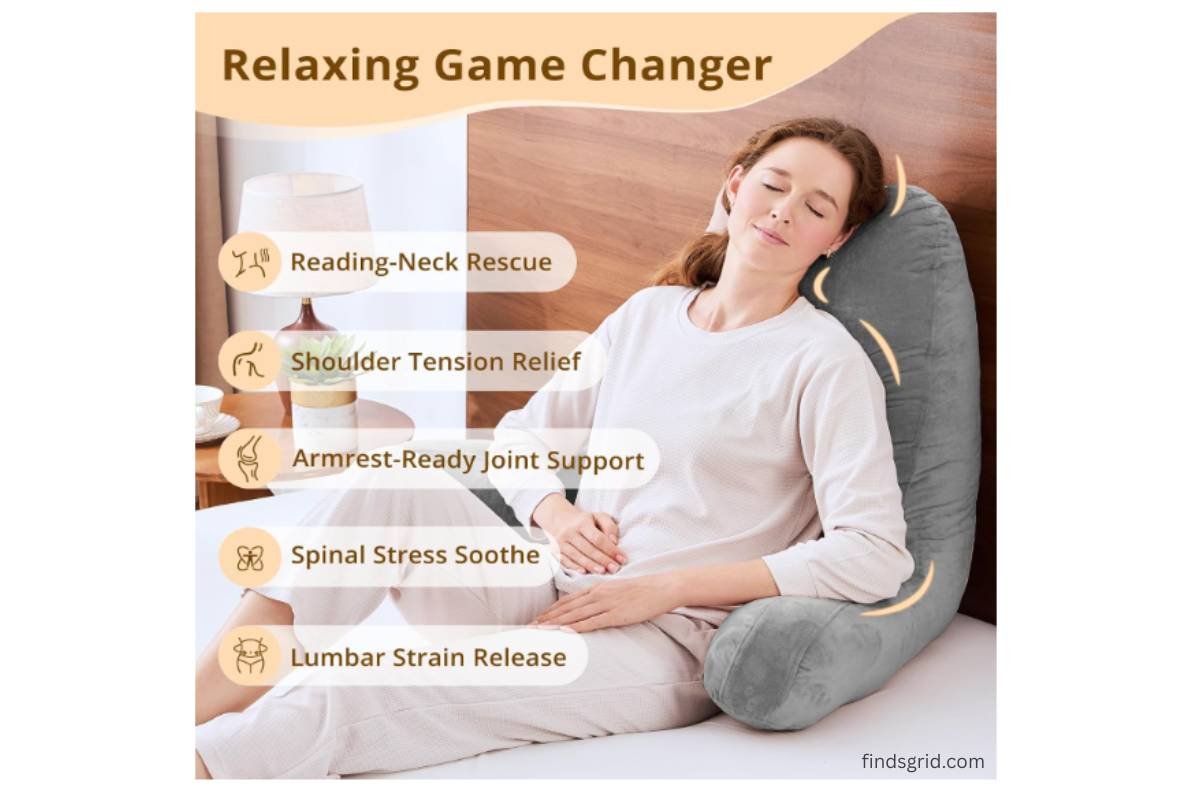
WFH folks working off a laptop from bed know this pain well. If your “office” is sometimes just your bed with a laptop on your lap, you’re probably holding tension in your neck and shoulders for hours without even realizing it until you stand up.
Late-night readers deal with this too. Even thirty minutes of reading a night adds up over weeks, and that strain doesn’t just disappear on its own. Proper support turns reading time back into something relaxing instead of something your body has to recover from.
College students in dorms have it rough here specifically because dorm beds almost never come with a headboard. You’re either against a bare wall or a pile of pillows sliding down within minutes, a structured backrest fixes a problem the furniture itself never accounted for.
And seniors, or really anyone already dealing with chronic back or neck stiffness, benefit the most from consistent support, since their bodies are already more sensitive to bad positioning during everyday stuff like reading or watching TV.
A Few Quick Questions
Not really, as long as you’re supported properly while doing it. The problem isn’t the activity, it’s doing it slouched or unsupported for long stretches, night after night.
If your lower back specifically feels stiff or achy after sitting up in bed (not just generally throughout the day), that’s usually your answer. Try this: feel for a gap between your lower back and whatever you’re leaning on. If there’s a gap, that’s probably where the problem is coming from.
For everyday reading and sitting, pretty much yes. A good structured backrest pillow can actually offer more targeted support than a flat headboard, since it’s shaped to follow your back instead of forcing you into one straight vertical line.
Last Thoughts
At the end of a long day, your wind-down time shouldn’t leave you sorer than when you started it. Most of the fix here really isn’t complicated, it comes down to giving your lower back, neck, and shoulders the kind of steady support that stacked pillows just weren’t built to provide.
Whether that means rearranging how you stack your pillows tonight, or eventually picking up a proper backrest, the goal’s the same: making the parts of your day you actually enjoy reading, catching up on a show, answering one last email, feel comfortable instead of something you pay for the next morning.